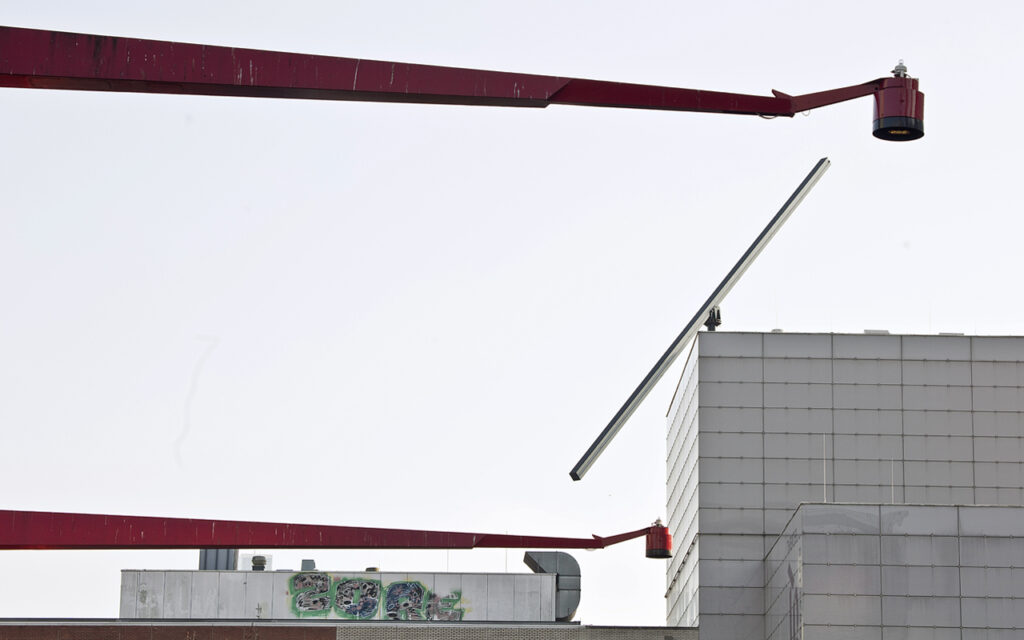
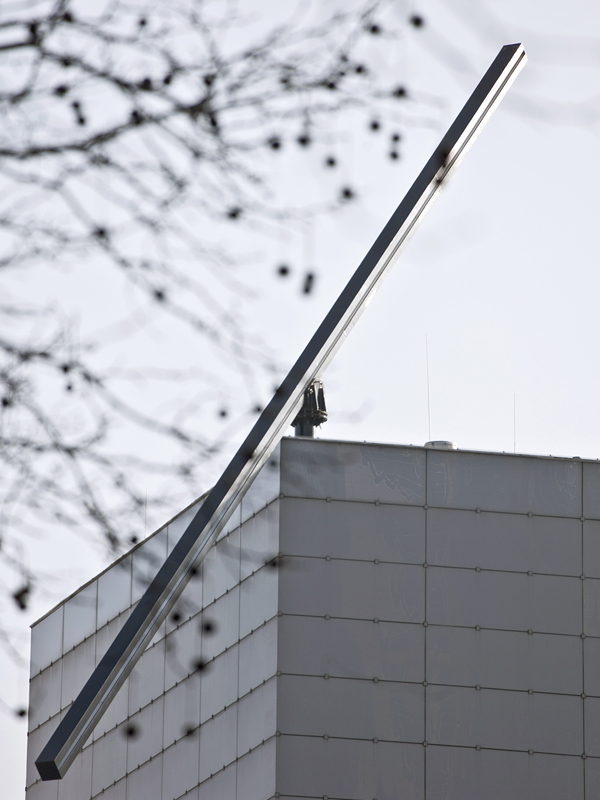
The 24 meter long Energy line The work that Jan van Munster created for the roof of the Rotterdam Schouwburg accentuates and enlivens – albeit primarily after sunset – the 'theatre factory' that architect Wim Quist designed as a successor to the post-war theatre. The austere building, which now houses Theater Rotterdam, was born out of necessity. In 1982 – a time when severe cuts had to be made to government spending – Quist was commissioned to design a complex in which the theatre was to be combined with social housing, offices, shops, and a parking garage. This task, heavily influenced by economic considerations, did not stand in the way of the creation of an original and functional theatre, as became apparent after the opening in 1988. The exterior of the new theatre was adorned with art. The work of Jan van Munster was – in contrast to the artwork Three Columns by George Rickey above the entrance – already ready at the opening. In the hall, Van Munster created red and blue lines of light in the floor and along the pillars. This artwork culminates on the roof in the form of a balancing beam, in which the red and blue lines of light reappear. The unlit square stage tower serves as a pedestal for this. The light beam at a height of 36 meters appears to be in precarious balance, but is in reality rock-solid. Jan van Munster remarked on this:Just as that beam on the edge of the abyss balances, so everyone who is involved in making theater in a good way always lounges on the dangerous border between falling and staying afloat.With the colors red and blue, Van Munster refers to two sides of the theater: red for the warm plush and blue for the modern experiment. From 2006 to 2010, a major renovation of the Schouwburg took place. Several changes were made to the lighting lines in the hall in consultation with the artist, but the Energy line on the roof was still present unchanged. Until March 2020, when the work had to be removed for thorough restoration work and various technical inspections. On March 21, 2022, the work the Energy line placed back on the roof; a 24-meter long colored stripe balancing on the tip of the roof.
Jan van Munster (Gorinchem, 1939 – Oost-Souburg, 2024) studied at the Academy of Visual Arts and Technical Sciences in Rotterdam and continued his education at the Institute for Applied Arts Education in Amsterdam. Initially Van Munster worked with wood, stone, bronze and glass. From the 1970s onwards his attention shifted more and more to the application of light. His work also became increasingly minimalist. In 2002 the artist received the Wilhelminaring for his entire oeuvre.
Oblique light line on the roof and on the floor and pillars in the hall
Materials
Neon
Dimensions
Length 24 m
years
1988
Client
Municipality of Rotterdam
Recruitment
Assignments Advisory Committee Rotterdam
Money source
Construction budget, assignment for construction
Owner
Municipality of Rotterdam
About the artwork
The 24 meter long Energy line The work that Jan van Munster created for the roof of the Rotterdam Schouwburg accentuates and enlivens – albeit primarily after sunset – the 'theatre factory' that architect Wim Quist designed as a successor to the post-war theatre. The austere building, which now houses Theater Rotterdam, was born out of necessity. In 1982 – a time when severe cuts had to be made to government spending – Quist was commissioned to design a complex in which the theatre was to be combined with social housing, offices, shops, and a parking garage. This task, heavily influenced by economic considerations, did not stand in the way of the creation of an original and functional theatre, as became apparent after the opening in 1988. The exterior of the new theatre was adorned with art. The work of Jan van Munster was – in contrast to the artwork Three Columns by George Rickey above the entrance – already ready at the opening. In the hall, Van Munster created red and blue lines of light in the floor and along the pillars. This artwork culminates on the roof in the form of a balancing beam, in which the red and blue lines of light reappear. The unlit square stage tower serves as a pedestal for this. The light beam at a height of 36 meters appears to be in precarious balance, but is in reality rock-solid. Jan van Munster remarked on this:Just as that beam on the edge of the abyss balances, so everyone who is involved in making theater in a good way always lounges on the dangerous border between falling and staying afloat.With the colors red and blue, Van Munster refers to two sides of the theater: red for the warm plush and blue for the modern experiment. From 2006 to 2010, a major renovation of the Schouwburg took place. Several changes were made to the lighting lines in the hall in consultation with the artist, but the Energy line on the roof was still present unchanged. Until March 2020, when the work had to be removed for thorough restoration work and various technical inspections. On March 21, 2022, the work the Energy line placed back on the roof; a 24-meter long colored stripe balancing on the tip of the roof.
Jan van Munster (Gorinchem, 1939 – Oost-Souburg, 2024) studied at the Academy of Visual Arts and Technical Sciences in Rotterdam and continued his education at the Institute for Applied Arts Education in Amsterdam. Initially Van Munster worked with wood, stone, bronze and glass. From the 1970s onwards his attention shifted more and more to the application of light. His work also became increasingly minimalist. In 2002 the artist received the Wilhelminaring for his entire oeuvre.
Oblique light line on the roof and on the floor and pillars in the hall
Materials
Neon
Dimensions
Length 24 m
years
1988
Client
Municipality of Rotterdam
Recruitment
Assignments Advisory Committee Rotterdam
Money source
Construction budget, assignment for construction
Owner
Municipality of Rotterdam
Jan van Munster -
Energy line (1988)
We use functional cookies to ensure that our site runs as smoothly as possible. We also use cookies to analyze website visitors.Allow allOnly functional